
Decide what the follow-up is meant to achieve
A quote follow-up should have a reason beyond “stay visible”. The customer may still be comparing scope, waiting for another decision-maker, checking finance, confirming a start date or trying to understand a technical difference between quotations. A useful follow-up helps move one of those decisions forward.
Before contacting the customer, look at the quote and ask what information is still likely to be unresolved. If the scope is complex, the next useful action might be a short clarification call. If the customer already gave a decision date, the most useful action may simply be to wait until that date rather than adding another message.
Confirm receipt before you start selling again
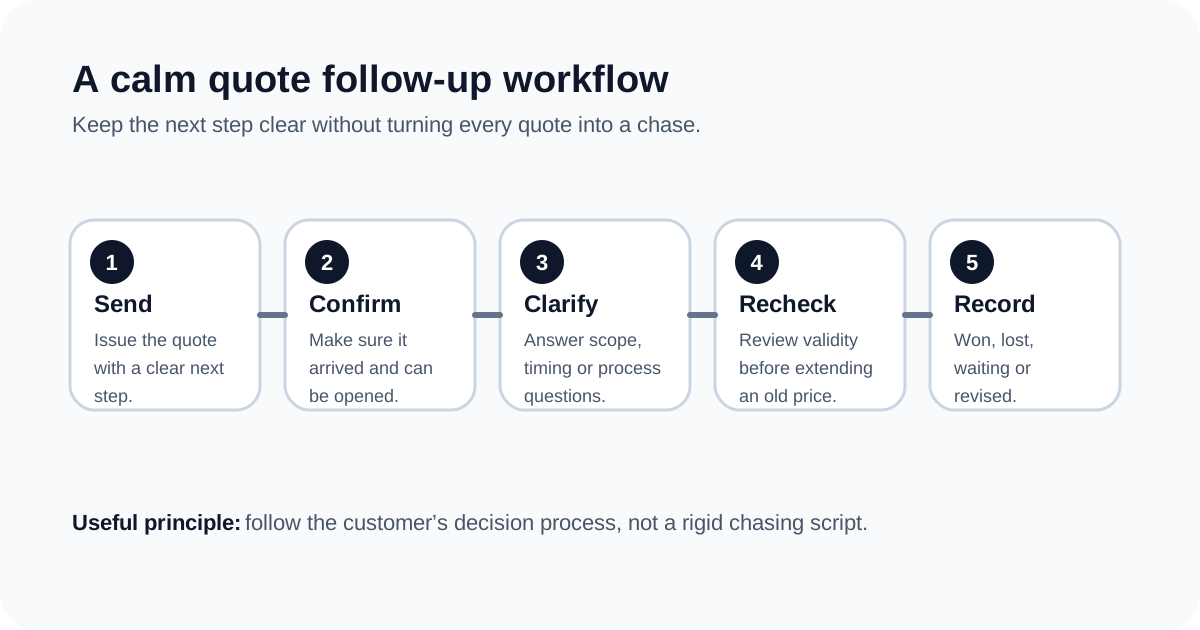
The first follow-up can be operational rather than persuasive. Confirm that the quote arrived, opens correctly and contains the information the customer expected. This is particularly useful when the quotation includes attachments, drawings, options or a long scope that may have been discussed verbally on site.
- Confirm the customer received the correct revision.
- Check that attachments or links work.
- Point out where major inclusions, exclusions and assumptions are recorded.
- Invite specific questions rather than asking only whether they are “ready to go ahead”.
Follow the customer's decision timing, not a rigid chase schedule
There is no universal follow-up interval that fits every trade, project value or buying process. A small repair, a domestic refurbishment and a multi-trade construction package can all require different decision time. What matters is whether the timing matches the conversation you already had with the customer.
If the customer said they would review the quote over the weekend, contact them after that point rather than the next morning. If they need approval from a partner, landlord, surveyor or internal manager, record that dependency and agree when it makes sense to reconnect. This makes the follow-up feel like part of the job process rather than a sales script running independently of it.
Ask one useful question instead of sending a generic reminder
Generic reminders are easy to ignore because they give the customer no new reason to respond. A more useful message focuses on the point that could still change the decision. For example, you might ask whether the scope matches what they expected, whether they want an option separated, or whether the proposed start window still works.
- Does the written scope match the work you want completed?
- Is any exclusion or allowance unclear?
- Do you need an alternative option priced separately?
- Has the target start date or project sequence changed?
- Is there another decision-maker who needs a clearer summary?
Keep the question genuine. Do not invent urgency, imply that another customer is about to take the slot when that is not true, or create artificial deadlines that are unrelated to real availability or cost assumptions.
Use quote validity as a recheck point, not a pressure tactic
Construction quotes can become stale because supplier prices, subcontractor offers, labour availability, programme assumptions or scope details change. A validity date gives both sides a point at which the original assumptions should be reviewed again.
If the customer returns after the quote has expired, do not automatically resend the same total or automatically increase it. Recheck the inputs first. If the underlying costs and scope are still sound, you can decide whether the quote can be reissued unchanged. If something material has moved, explain the changed assumption and issue a revised version.
This is also why validity should not be used as manufactured urgency. The date is most credible when it reflects how long you can reasonably stand behind the assumptions in the quotation.
Do not turn silence into an automatic discount
When a customer does not respond, it can be tempting to reduce the price before you know what is blocking the decision. That can damage the commercial logic of the quote and may not solve the actual problem. The customer might prefer a different scope, need a later start date or simply be waiting for another quotation.
If price really is the obstacle, revisit scope and options before quietly eroding margin. A smaller defined scope, an optional item removed or a different specification can be a clearer commercial choice than discounting the same work without changing what you must deliver.
For the arithmetic behind price changes, see our guide to markup vs margin in trade quotes.
Close the loop and record the outcome
Not every quote will turn into work, and a healthy pipeline needs a clear way to stop chasing. After reasonable follow-up, record the outcome as won, lost, postponed, revised or no decision. If the customer gives a reason, capture it without turning one comment into a universal conclusion.
Over time, these outcomes are more useful than a folder full of sent PDFs. You can see whether quotes are losing momentum because of response time, unclear scope, start-date mismatch, price position or work that was never really ready to proceed.
- Date the quote was issued and the revision sent.
- Record the promised customer decision point where one exists.
- Log meaningful questions or requested changes.
- Record the final outcome and reason where known.
- Feed recurring lessons back into the quoting process.